In the Roadrunner cartoons, Wile E. Coyotes would chase his nemesis relentlessly, even running off cliffs and continue running into mid-air. Only when he looked down, and realized there was no longer any support, did he fall. This gives rise to the term “a Wile E. Coyote moment” in financial markets, when investors realise the stock market has been running without support for a long time, and prices that should have long since been gradually coming down suddenly collapse.
Coyotes can defy gravity for years in the markets — but generally there comes a point when gravity catches up to them. This year has seen the large tech stocks having to readjust to a world where persistent inflation has forced central banks to push up interest rates, thus ending the years of cheap money and the ability to defy gravity.
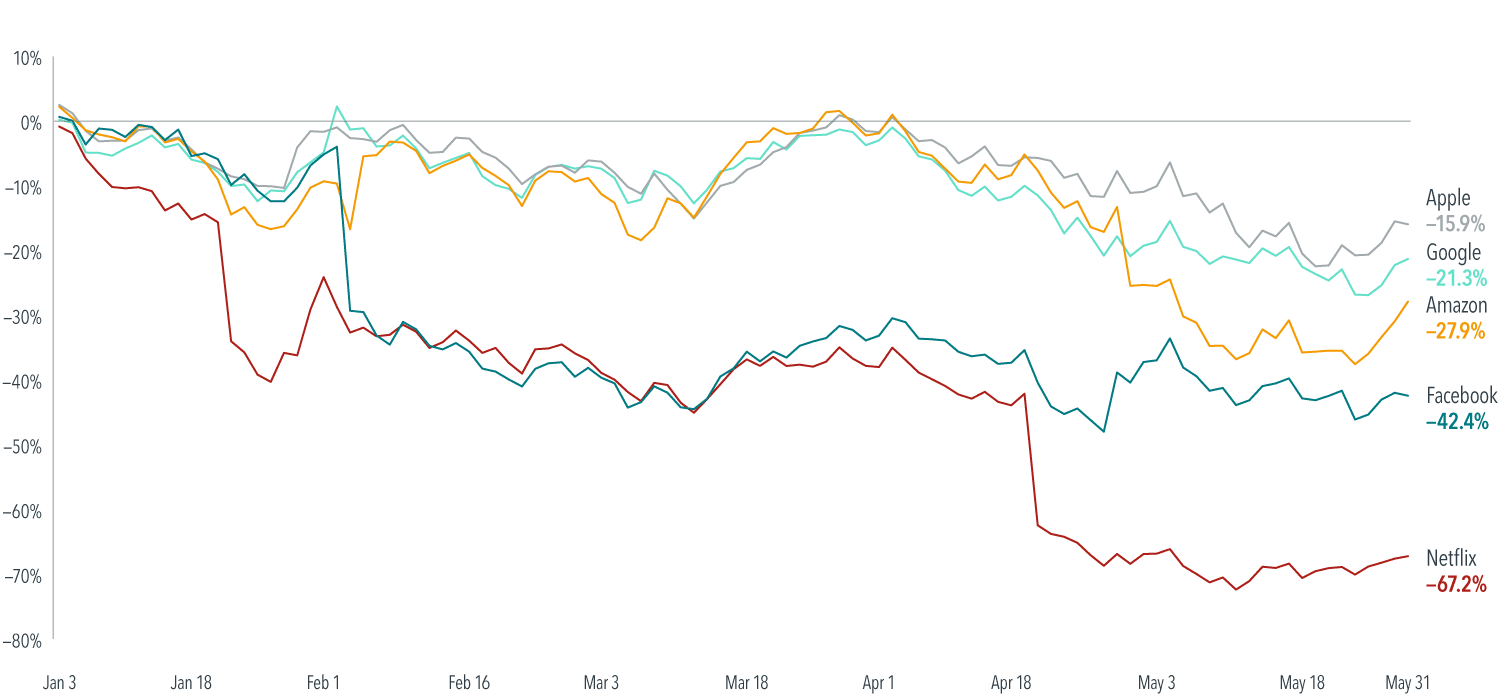
For the past decade, the FAANGs have had a stellar trajectory. Between 2012 to 2021 the FAANGs returned 28.02% per year on average. However, investors expecting the FAANG stocks to continue its bullish trajectory over the past year have been left disappointed in the recent downturn in 2022. The overall market in the US is still down almost 19 per cent. The NYFANG+ index that contains the mega techs (Facebook parent Meta Platforms, Apple, Amazon, Google parent Alphabet, Microsoft and Netflix are among them) is now down more than 40 per cent. That’s a stark divergence.
Source: Dimensional. Past performance is not a guarantee of future results.
Microsoft, Google-owner Alphabet and even Apple have all suffered write-downs to varying degrees this year, but the fall from the sky of Meta Platforms Inc., the Facebook parent, and Amazon has been particularly hard. Meta – who has suffered the most – was smashed, losing 25% of its market capitalisation in a day, underperforming the S&P significantly. Poor investment decision resulting in negative NPVs, such as the metaverse project, is one of the main attributions for this decline.
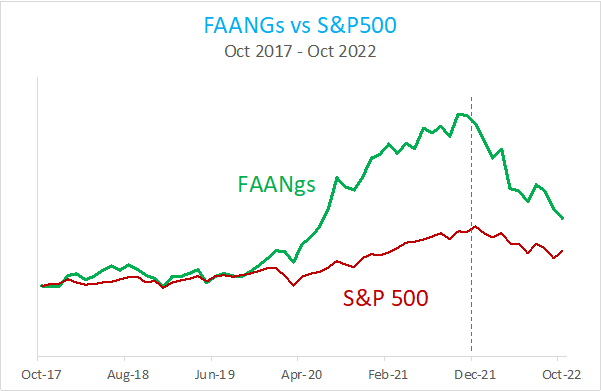
As the chart above shows, prior to the pandemic, these stocks were still outperforming the market, further boosted as a result of the lockdowns, shifting to a work from home environment and with the government stimulus’ encouraging exorbitant amount of spending. As that’s abated, revenue growth has understandably slowed.
Investors have fully grasped it is no longer possible to simply extrapolate the trend of past returns into the future. FAANG stock performance in recent years reflected these companies achieving financial success that exceeded most investors’ expectations. That’s in the past, though. Even if these companies sustain their success, it may not translate to spectacular future returns. This is not to imply that there is anything wrong with these companies and they will continue to deliver product and services that are sought after by consumers. But their valuations are at last being examined critically.
The takeout for an investor is that trying to time the “next great thing” in the stock market is a difficult game to play. Which company will turn out to be the best investment? What sector will be the strongest performer? Which country will offer the highest return? The truth is nobody really knows.
Fortunately, you don’t need to rely on guesswork to invest well. It turns out that for long term investors, a diversified approach that includes all segments of the market – both domestic and international – is a great way to increase your opportunity set, manage overall risk and improve the reliability of outcomes.
1FAANG lost its “G” in 2015 and its “F” in 2021 when Google and Facebook rebranded themselves as Alphabet and Meta Platforms, respectively. Netflix has been hit particularly hard, and the company has dropped behind its peers in terms of growth and prominence. So after booting Netflix from FAANG, replacing it with Microsoft and adjusting for the corporate name changes, we now have a new acronym: MAMAA—for Meta, Amazon, Microsoft, Apple and Alphabet
2We use the FANG+ Index, which has ticker code NYFANG, to plot the performance of these large tech stocks. The NYSE FANG+ Index provides exposure to 10 tech giants – Apple, Amazon, Netflix, Alphabet (Google), Microsoft, Alibaba, Nvidia, Baidu, Tesla and Meta (Facebook).
This article was inspired by Wile E. Coyote Moment as Tech Goes Off the Cliff by Bloomberg Opinion columnist John Authers. Economist and New York Times editorial writer Paul Krugman is usually credited with making the connection between Wile E. Coyote with economic disaster in 2003.